Four problems. One root cause.
Every one of these looks like a people problem, a process problem, or a bad hire. They're the same problem wearing four faces: nobody taught the new job, and nobody built the system that would have caught it early.
Why good engineers become bad managers
The skills that got them promoted are the skills they now have to stop using. Every instinct — jump in, take the keyboard, be the one with the answer — turns from an asset into a liability overnight, and nobody tells them.
Why promotions fail three months in
A promotion doesn't make someone a leader. It changes their job. The title is administrative; the transformation hasn't happened yet — and it won't happen because of anything on a business card.
Why delivery collapses while every status stays green
Nobody's lying. The truth just stopped travelling. By the time it shows on a dashboard, the cheap fix is six weeks gone and you're paying for the expensive one.
Why teams stop trusting leaders
Trust doesn't collapse. It corrodes — quietly, a little more each week — until people redirect their energy from doing the work well to not getting caught. The leader is usually the last to know.
What metal are you?
Your team has already decided what kind of leader you are — not from your intentions, but from how they behave around you. Most leaders find out two years late, in transfer requests and careful silences.
This assessment tells you now: your resting metal, the direction you slide under pressure, and the one sentence to change first. It takes five minutes and it won't flatter you.
- Your metal — Platinum through Lead — and which way you slide
- The R.E.S.E.T. one-page protocol
- The Silent Failures exposure check for your team
Enter your email and I'll send it straight over — plus a short note most weeks on leading without drowning. Unsubscribe anytime.
The Six Metals of Leadership™
Most leadership models sort you into a personality type where every type is equally fine. This one doesn't. It grades leaders the way a metallurgist grades a metal — not by how shiny it looks, but by how it behaves under load, and what it leaves behind in people. Six grades, best to worst.
People come out of their orbit bigger than they went in. They grow leaders, not followers, and measure themselves by who they built.
They bring out people's best and then guard it. Reliable, fair, honest about hard things. People do their finest work here and know it.
Genuinely good, genuinely valuable — but they lead by rescuing. If it matters, I'll handle it. The team is grateful, and a little stunted.
They manage tasks, not people. Track the status, keep the order, catch the slips. Nobody feels seen, so nobody spends more of themselves than the job requires.
Rarely cruel, usually frightened. Everything routes through them, every error gets hunted, and the standard lives in their head where nobody can see it or predict it.
People are instruments for the leader's agenda. Credit flows up, blame flows down, favourites are anointed, and the good ones either leave or bend.
Here's the part that matters: metals aren't fixed identities. Everyone slips a rung under pressure — the calm Gold goes Bronze on a bad week; the steady Silver goes Rust when the stakes spike. The question isn't what metal you are on your best day. It's what your resting metal is, and which way you slide when it gets hard — because that's the version your team actually meets. The work is to catch it yourself, early, before it costs anyone anything.
Five ways in — from one session to a whole system.
Not twenty services. Five, each with a clear outcome, each built on the same frameworks. Start wherever you are.
A single, unflinching session. We place you on the metals ladder honestly, find which way you slide under pressure, and trace where it's already costing you.
For the leader carrying it alone. Six Metals for self-awareness, Silent Failures for what's slipping around you, plus stakeholder influence and the conversations you've been avoiding.
Zero Fire Zone™ — take your team off permanent emergency mode. Or the Six Metals lab, or the Silent Failures team diagnostic. Real artefacts, your rooms, no theory that doesn't earn its place.
You're pushing engineers into delivery and leadership roles with no system. This is the system — cohort-based, built on your real projects, with assessments and scorecards so you can see who's actually ready.
A programme is in trouble and nobody can say cleanly how late it is. I rebuild the instruments — charter, scope, critical path, earned value, RAID — until the room can answer the question the sponsor actually asked.
Where a specific capability gap needs closing rather than a whole system built.
Keynotes for conferences, offsites and leadership summits.
Not training. Forty-five minutes that leaves a room of leaders with a language they didn't have when they walked in — and usually, a conversation with their L&D lead on the way out.
Five conditions that slip while every dashboard stays green — and the ten seconds after something goes wrong, where a leader's real character gets decided.
They promoted you for the work you do, then needed you to stop doing it. Why the skills that earned the title are the ones you now have to retire.
The star-to-manager trap, the identity wound underneath it, and the scoreboard nobody tells you has changed.
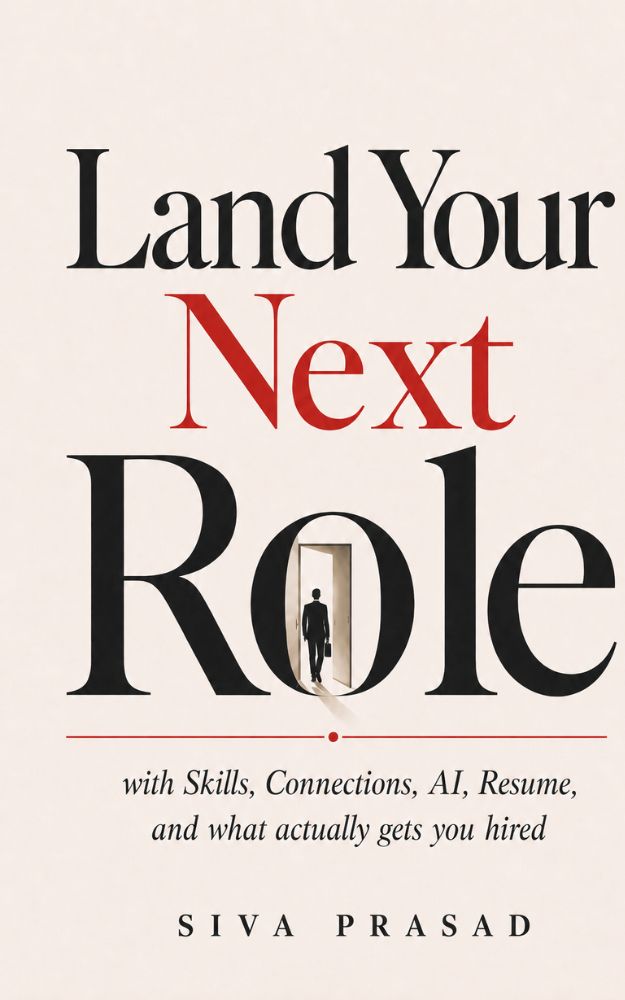
500 applications. Zero replies.
Before you can lead, you have to get in the room. Land Your Next Role is the manual for the modern senior job search: how ATS and recruiters actually work, a 9-prompt AI workflow, and a 15-minute application system. For anyone forced out, plateaued, pivoting, or returning after a break.
Moving into Scrum Master, Agile Coach or leadership?
1:1 coaching for project managers and delivery professionals: interview scenarios, metrics, Jira, SAFe, and the step into leadership. Sessions from ₹1,500.
Designed as learning journeys, not one-off workshops.
Content, community and coaching together — so people don't just attend sessions, they change how they think and work.
Live sessions, reflection exercises and on-the-job experiments. We bring your real artefacts — roadmaps, backlogs, decks, metrics — into the room.
- Live, interactive sessions (remote or in-person)
- Assignments linked to real projects
- Peer learning and community spaces
- Manager involvement where it matters
Before-and-after self assessments, manager feedback, and observable shifts in how work actually gets done.
- Baseline and post-program reflections
- Manager and SME feedback loops
- Simple scorecards for role readiness
- Recommendations for ongoing development
Hi, I'm Siva Prasad.
I want to tell you about a call I was on. The project manager was there. The delivery team was there. The client was there. And within ten minutes it was clear that every single person responsible for this project was lost. Someone asked what we'd actually delivered so far, and the room went quiet.
These were not incompetent people. The team could build. The PM cared. The client was reasonable. What they lacked wasn't talent or effort — it was a system. Nobody had built the thing that would have let them answer those questions, so they sat in the fog together, each one privately certain the others must know something they didn't.
I've spent two decades leading cross-functional engineering and delivery teams across India, Singapore and the Middle East, and I've come to believe that room is the most common room in our profession. Teams don't fail because people lack technical ability. They fail because the job changes — and nobody teaches the new one.
Today I help technical professionals become trusted leaders — and organisations build leaders people want to follow.
“Calm leadership. Clear decisions. Measurable outcomes.”
- Curious? Take the free Six Metals assessment
- One leader? Book a 90-minute diagnostic
- One team? Zero Fire Zone™ half-day workshop
- An organisation? Leadership Academy or Delivery Recovery
- An event? Keynote enquiry
Selected work & outcomes.
A few examples of the kind of work I do.
Stabilized delivery by introducing operating rhythm, risk controls, stakeholder comms, and outcome tracking.
- Scope: Program delivery + governance
- Output: Reporting + cadence + ownership model
- Result: Predictable execution and fewer escalations
Leadership-focused Scrum/Kanban enablement: metrics, accountability, and decision-making under uncertainty.
- Audience: Managers / Directors
- Output: Playbooks + metrics + coaching plan
- Result: Better throughput and healthier collaboration
Designed a structured learning + assessment journey for PM/Delivery roles aligned to real project artifacts.
- Output: Curriculum + assessments + scorecards
- Result: Faster onboarding & higher ownership
Let's design the right program for you.
Share a bit about your organisation, roles and goals, and we'll explore how Serene Sprints can support your people and teams.
Prefer email or LinkedIn? You can also reach out directly.
Take the free assessment instead. No call, no pitch — just find out what metal your team would say you are.
What metal are you? →