NewJob-Ready Program with mock interviews & a real project simulation · Pay half now, the rest when you’re hiredSee plans →
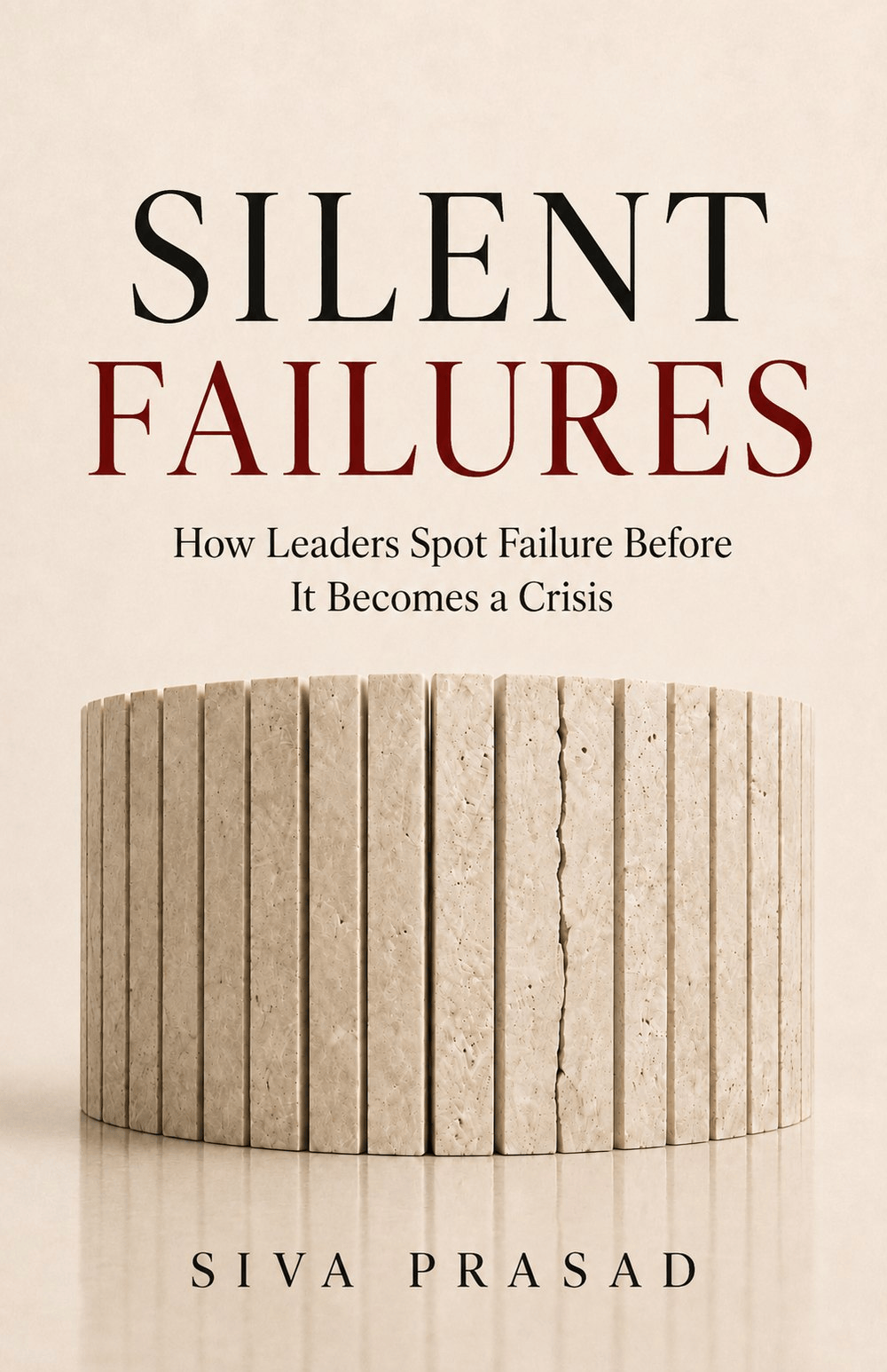
Silent Failures by Siva Prasad — book cover

Free diagnostic · From the book Silent Failures

The project is green.
The team is not.

Failure is never sudden. It only becomes visible suddenly.

Forty questions across the five conditions every team runs on. It won't tell you whether you're a good leader. It will tell you which condition is slipping right now — and roughly how long you've been unable to see it.

Five minutes · No signup to take it · From Silent Failures: How Leaders Spot Failure Before It Becomes a Crisis

Five conditions. Five shadows.

Leadership is the work of creating and protecting the conditions in which a team can win. Each condition has a shadow — the specific way it fails when nobody is watching it. The shadow always arrives quietly, and it always arrives first.

Before you start

Score yourself on the team you actually have this week, not the one you're building toward. Answer fast — your first instinct is more accurate than your considered one, because the considered one has time to argue.

Forty statements, eight per condition, scored on how true each one is of your team right now: always is 2, sometimes is 1, rarely — or never — is 0. Nothing is sent anywhere until you choose to send it.

You have the reading. Here's the rest of it.

The diagnostic is Appendix B of a book that spends twenty-four chapters on how each condition slips, what it costs, and what to do in the ten seconds after you notice.

Silent Failures

Paperback & Kindle · Amazon and all major stores

Five conditions, their shadows, the R.E.S.E.T. protocol, nine leadership simulations you can take the seat in, and the diagnostic tools to scan your team weekly.

  • Five weekly scan tools, one per condition
  • Nine simulator scenarios with the decision made explicit
  • The Honest Window, Judgment Hygiene and the Neutral Chair
  • The full forty-question self-diagnostic
Buy on Amazon

Run it on your team

Half day · In person or remote

Your team takes this diagnostic independently and in writing, before anyone hears anyone else's number. Then we look at the spread. The gap between what you scored and what they scored is usually the most useful thing in the room.

  • Aggregate scores, plotted — including the variance
  • The condition your team agrees is slipping
  • One live simulator case, run in your context
  • One R.E.S.E.T. intervention you leave holding
Enquire about a session